
AIM+ Anti-jamming
Spectrum Defense & Mitigation
AIM+ Anti-Jamming provides real-time detection and mitigation of RF interference across narrow-band and wide-band threats using spectrum monitoring, configurable notch filters, and an advanced Wide-Band Interference (WBI) mitigation engine that outperforms simple pulse-blanking. The receiver UI exposes spectral plots so operators can identify interference sources quickly.
Jamming Rarely Looks Dramatic
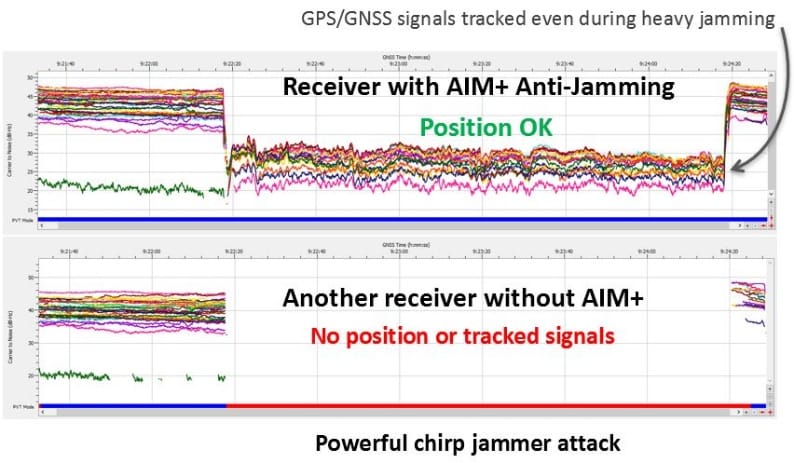
It often begins with a little less range, then RTK gets slower, then a fix collapses entirely. AIM+ Anti-Jamming is built to prevent that slide by actively listening to the spectrum and adapting to interference in real-time. Instead of brute-forcing through noise, the receiver intelligently shapes the RF input to recover useful satellite energy.
When GNSS is interference-sensitised rather than interference-blind, uptime improves. AIM+ allows receivers in mines, rail corridors, UAV corridors and logistics hubs to continue operating while lesser receivers fall silent. The system reduces frantic troubleshooting, travel downtime, and survey re-runs — the invisible cost most teams ignore until they pay it.
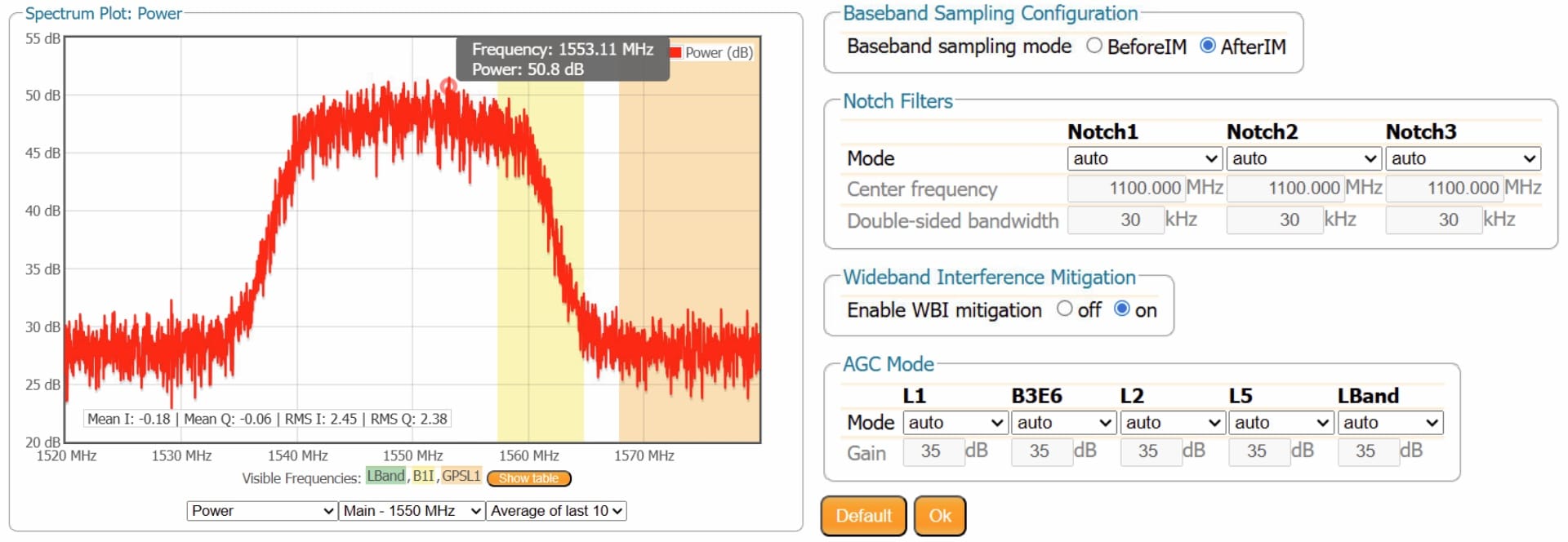
Singal status can be monitored and adjusted dynamically
AIM+ applies continuous spectral analysis at baseband which helps classify narrow vs. wideband and pulsed vs. continuous interferers. The spectrum plot is computed from baseband samples (ADC output). Up to three notch filters can be configured (auto/manual) to surgically remove narrow spectral interference (e.g., L2 band spurs). This reduces the effect on the GNSS bands without harming useful signals. The Wide-Band Interference (WBI) mitigation system reduces the effect of pulsed interferers and is more effective than traditional pulse-blanking. It’s designed to maintain tracking during complex pulsed or chirp jammers.
Spotting the Spikes
When radio noise or deliberate jammers raise the local noise floor, GNSS receivers can lose satellites, drop RTK fixes, or experience degraded accuracy. Septentrio’s anti-jamming approach is built around continuous spectrum awareness and layered countermeasures that act automatically or under operator control. Rather than a single blunt tool, AIM+ uses surgical filters for narrow, persistent tones and a broad-band approach for complex pulsed or chirp interferers that would defeat simple notch filters. Practically, that means a site or rover can often continue operating through a local interference event that would otherwise stop lower-grade receivers cold.
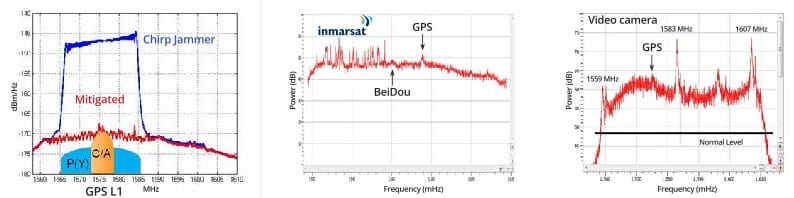
Actual examples of interference succefully mitigated
© Septentrio
AIM+ Anti-Jamming in the Field
AIM+ sees the spike on the internal spectrum analyser, automatically applies an adaptive notch centred on the interferer, and within seconds the receiver recovers centimetre-level RTK. In contrast, a chirp jammer hidden in a vehicle passing under a gantry can produce fast, wide-sweeping interference; here the Wide-band Interference Mitigation Unit (WIMU) reduces the jammer’s range from hundreds of metres to a few metres so only the offending vehicle (and not all receivers in a corridor) is affected.
Picture a survey crew working near a radio tower upgrade — GLONASS L2 begins to shimmer with spikes, age-of-correction grows, baseline drifts. AIM+ automatically detects the spike, places a narrow digital notch around the offending tone and restores healthy tracking. RTK lock returns without the operator even walking back to the rover. Now imagine the more complex case: a vehicle passing through a port with a wideband chirp jammer. AIM+ uses wide-band interference mitigation to shrink the jammer’s footprint so it disrupts metres, not city blocks. That difference determines whether operations continue or shut down.